
Being Right Convinces Nobody. Making It Easy Does.

What building an upcycled food category taught me about creating markets, overcoming commercial barriers, and turning individual successes into systemic change.
At How to Web in Bucharest earlier this month, someone asked me what I wish I'd been told before starting TransFoodMission.
I answered before I could dress it up: that the market doesn't exist until someone pays for it.
For the first few years, I was convinced a good enough argument would do the job. Less waste, better margins, measurable impact. The logic was solid, and people nodded along. Then nothing moved, because agreeing with you is free and changing a listing isn't.

I thought it was a product problem
I started out believing food waste could be solved one upcycled product at a time. So we built our own brand, Secontaste: several products, several side streams, sold in five countries. It proved upcycled food could be made and sold.
Then a manufacturer asked me how we'd done it, and then another one did. They weren't asking to buy our product. They wanted the path.
That's when it landed. We could launch ten more products and the food system wouldn't notice. But if a retailer had a dedicated upcycled category, every manufacturer in Europe would suddenly have a reason to look at its own side streams differently.

Everyone was waiting for someone else
The manufacturers I spoke to had valuable by-products and strong technology. Most were interested. Few wanted to invest before a retailer showed demand.
The retailers weren't asking for upcycled products at all. They wanted a way to stand out from the competition, a more resilient supply chain, and a credible route to lowering their environmental footprint.
Both sides could benefit from the same outcome, and each was waiting for the other to move first. The problem was never a shortage of upcycled ingredients. Plenty are being developed. Very few ever make it into a product on a shelf.
One product is proof. A category is infrastructure.
So we built the shelf
In 2024, with Rohlik Group, we launched Europe's first dedicated upcycled retail category in the Czech Republic: one destination, more than 40 products, and a new way for shoppers to discover upcycled food.
It worked commercially, not just environmentally. In its first 12 months the category generated over €330,000 in net sales and sold more than 87,000 products. It also helped give 19 tonnes of surplus ingredients and by-products a second life, with an estimated 104 tonnes of CO₂ emissions avoided (roughly equivalent to the annual emissions of 23 average US passenger vehicles).
Here is what "second life" means on a shelf: high-protein ice cream made from the press cake left after cold-pressing oil, and kombucha made from surplus cucumbers. Neither required a new ingredient to be invented.
In 2025 we expanded the category across Rohlik's four other European markets. Today it features more than 200 products from over 55 producers across five countries, and has repurposed 150 tonnes of food through upcycled products since launch.
But the numbers only tell part of the story. Building this category taught us a few things about what actually makes upcycling work.

Three things that are harder than they look
Side streams aren't free
The common assumption is that a by-product makes a cheap product. Often it's the opposite. Getting a side stream to food-grade requires handling, processing, and sometimes new equipment. The upcycled version can sometimes cost more to make than the virgin one.
Take the beetroot and carrot fiber left over from juice pressing. Before we could use it in one of our porridge flavors, it needed to be dried. But drying was only economically viable at volumes far beyond what we needed for our own product at the launch phase. So we had to find more manufacturers willing to buy the same side stream to make processing worthwhile.
The lesson? A side stream might be abundant, but turning it into a viable ingredient requires scale.
Impact doesn't have a budget line yet
The impact is real: 578 tonnes of CO₂ prevented so far. And our work can also support retailers' Scope 3 reduction efforts, particularly when surplus from their own warehouses is turned into valuable ingredients and products instead of waste.
But that environmental value doesn't necessarily have its own line in the P&L. Sustainability reporting is making it more visible, but commercial incentives haven't fully caught up.
So the pitch has to be "this sells, and by the way it's also good."
You win on margin and collect the purpose on the way.
Nobody buys it because it's upcycled
More than 87,000 products sold in the first year taught us this. People buy because it tastes good and the price makes sense. Upcycling breaks the tie.
We've had products with a lovely sustainability story die on the shelf because the texture was off. We've had others sell out where most shoppers never noticed the claim. So we stopped leading with the mission on the pack and started leading with the product. The story still matters, but it can't compensate for a product that doesn't deliver.
What actually moved people
The first retailer didn't say yes because they understood food waste. They said yes because we handed them a finished category they didn't have to build from scratch. The suppliers were found, the products developed, the listing ready and the impact measured.
Years of good arguments never did what that one finished category did. They didn’t buy the mission. They bought the work we'd already put in for them.
And that's perhaps the most important thing I've learned about creating a market: people don't need another reason to believe in the opportunity. They need fewer barriers to acting on it.
Where we are now
We don't want upcycling to stay a niche. We want it to become a normal part of how food is made.
But here's the irony. Making upcycling easy for our partners still takes an enormous amount of work behind the scenes.
We find the right ingredients, connect the right people, figure out what can replace what, help develop products, build categories and measure the impact.
It works. We've proved that. But if every new opportunity requires us to do all of this manually, there's a limit to how far we can go.
And we don't think the food system can afford to move that slowly.
So that's what we're working on next.
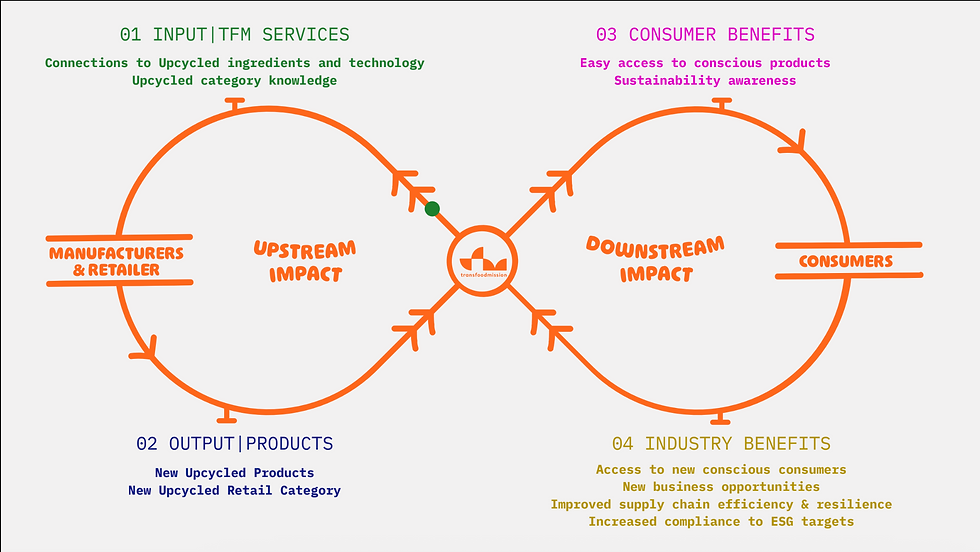
We're taking everything we've learned from building these categories and turning it into a platform that can do the heavy lifting: making it easier for retailers to discover opportunities in their own supply chains, for manufacturers to find viable ingredient alternatives, and for suppliers to connect with real market demand.
Because the opportunity is already there. The ingredients exist. The technology exists. The demand can be created.
What's missing is an easier way to bring it all together.
We're sure we'll discover a whole new set of challenges along the way. We always do.
But if there's one thing these past few years have taught me, it's this:
Building with purpose is worth it. But being right convinces nobody. Making it easy does.


